Post Views: 68
Introduction
Agriculture has always been closely connected to human civilization. The food we eat, the livelihoods of millions of farming families, and the health of our environment all depend on how we cultivate the land. For decades, modern agriculture has focused heavily on increasing production through synthetic fertilizers, chemical pesticides, intensive irrigation, and other external inputs. While these practices have contributed to significant increases in food production, they have also raised concerns about soil degradation, water pollution, biodiversity loss, pesticide residues, and the long-term sustainability of farming.
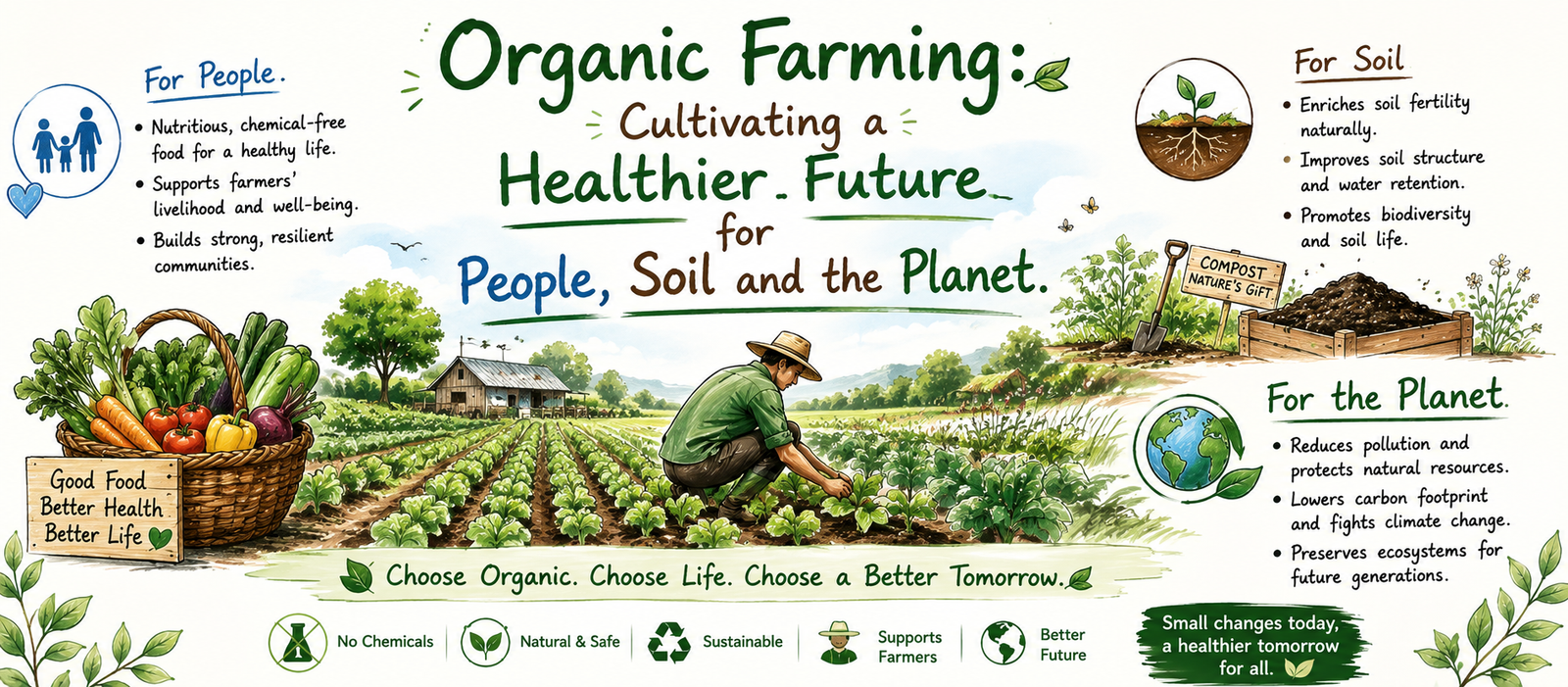
Organic farming offers a different approach. It is a farming system that works with natural ecological processes rather than depending primarily on synthetic chemical inputs. Organic farmers focus on building healthy soil, maintaining biodiversity, recycling organic matter, using natural methods for pest management, conserving resources, and producing food through a more balanced relationship with nature.
Organic farming is not simply about avoiding chemicals. It is a complete agricultural philosophy that considers the health of the soil, crops, animals, farmers, consumers, and surrounding ecosystem as interconnected.
What Is Organic Farming?
Organic farming is an agricultural production system that emphasizes natural cycles and ecological balance. It generally avoids the routine use of synthetic fertilizers, synthetic pesticides, genetically modified organisms, and other prohibited inputs, while encouraging practices such as composting, crop rotation, biological pest management, green manuring, natural soil enrichment, and biodiversity conservation.
The basic principle is simple:
Healthy soil leads to healthy plants, healthy ecosystems and, ultimately, a healthier food system.
Instead of treating soil merely as a medium in which plants grow, organic agriculture considers soil to be a living ecosystem containing microorganisms, fungi, earthworms, organic matter, minerals, air and water.
Why Is Organic Farming Important?
The importance of organic farming extends far beyond the food on our plates. It influences environmental sustainability, agricultural resilience, rural livelihoods and long-term food security.
1. Protecting Soil Health
Soil is one of the most valuable resources on Earth, yet it is often taken for granted.
Organic farming places soil health at the center of agricultural production. Farmers may use compost, farmyard manure, crop residues, green manure, mulching and crop rotation to maintain soil fertility.
Healthy organic matter improves soil structure and helps the soil retain moisture and nutrients. It also supports earthworms and beneficial microorganisms that contribute to natural nutrient cycling.
A healthy soil ecosystem can therefore become a foundation for productive and resilient agriculture.
2. Reducing Dependence on Synthetic Chemicals
Conventional agriculture may rely heavily on synthetic fertilizers and pesticides. Organic farming instead emphasizes preventive and ecological approaches.
For example, organic farmers may manage pests through:
Crop rotation
Intercropping
Beneficial insects
Biological control
Trap crops
Physical barriers
Mechanical weed management
Botanical preparations where permitted
Maintaining biodiversity
The goal is not necessarily to eliminate every insect or disease from a farm. Instead, the objective is to maintain an ecological balance in which pests are managed without unnecessarily disturbing the wider ecosystem.
3. Supporting Biodiversity
A healthy agricultural landscape contains much more than a single crop.
Organic farming can encourage biodiversity through mixed cropping, crop rotation, hedgerows, flowering plants, agroforestry and preservation of natural habitats.
Biodiversity provides important ecological services. Birds, bees, butterflies and other organisms can contribute to pollination and pest regulation, while microorganisms help break down organic matter and cycle nutrients.
Greater biodiversity can also make agricultural systems more resilient to environmental stresses.
Organic Farming and Water Conservation
Agriculture is one of the world’s major users of freshwater. The way farms are managed therefore has a direct impact on water resources.
Organic farming practices that increase soil organic matter can improve the soil’s ability to hold water. Mulching can reduce evaporation, while healthy soil structure can improve water infiltration.
Another important aspect is reducing contamination. Responsible organic farming seeks to prevent agricultural pollutants from entering rivers, ponds, groundwater and other water sources.
Water conservation in organic agriculture can include:
Drip irrigation
Rainwater harvesting
Mulching
Soil-cover crops
Improved soil organic matter
Appropriate irrigation scheduling
Watershed management
Crop selection suited to local conditions
Organic farming should therefore be viewed as part of a broader approach to sustainable water management.
Organic Farming and Climate Change
Climate change presents major challenges to agriculture. Increasing temperatures, irregular rainfall, droughts, floods and changing pest patterns can affect crop production.
Organic farming can contribute to climate resilience through improved soil management and diversification.
Soils rich in organic matter can store carbon and improve water-holding capacity. Crop diversification can reduce dependence on a single crop, while agroforestry can combine agricultural production with trees and other perennial vegetation.
However, it is important not to present organic farming as a complete solution to climate change. The climate benefits of any agricultural system depend on how it is implemented, the crops grown, the location, farm inputs, yields, transportation and many other factors.
The broader goal should be lower-impact, resource-efficient and resilient agriculture.
The Role of Compost in Organic Farming
Compost is one of the most important tools used in organic agriculture.
Farm and household organic materials such as crop residues, leaves, plant material and suitable animal manure can be decomposed into nutrient-rich compost.
Compost can:
Increase soil organic matter
Improve soil structure
Support beneficial microorganisms
Improve moisture retention
Help recycle nutrients
Reduce organic waste
Instead of viewing agricultural residues as waste, organic farming encourages farmers to see many of these materials as valuable resources that can return nutrients to the soil.
This creates a more circular agricultural system.
Crop Rotation: A Natural Agricultural Strategy
Growing the same crop continuously in the same field can encourage particular pests, diseases and nutrient imbalances.
Crop rotation involves growing different crops in a planned sequence.
For example, a farmer may rotate cereals with pulses or other crops. Leguminous crops can contribute to nitrogen management through biological nitrogen fixation, while different crops have different rooting patterns and nutrient requirements.
Crop rotation can help:
Improve soil fertility
Break pest and disease cycles
Reduce weed pressure
Improve soil structure
Diversify farm production
Reduce dependence on external inputs
It is one of the oldest and most valuable principles of sustainable agriculture.
Organic Pest Management
Organic farming does not mean that farmers simply allow pests to destroy their crops.
Instead, organic pest management generally follows an ecological approach.
Farmers can first focus on prevention by selecting suitable varieties, maintaining healthy soil, rotating crops and encouraging beneficial organisms.
If pest pressure increases, farmers can use appropriate biological, mechanical or other permitted methods.
For example, beneficial insects such as ladybirds and certain predatory insects can help control pest populations naturally.
This approach recognizes that an agricultural field is an ecosystem rather than an isolated production unit.
Organic Farming and Farmers
Farmers are at the heart of the food system.
Organic farming can create opportunities for farmers to build more diverse agricultural enterprises. Instead of depending entirely on one crop, farms can integrate vegetables, fruits, grains, pulses, livestock, herbs, trees and other products where appropriate.
Diversification can potentially provide multiple sources of income and reduce dependence on a single market or crop.
However, organic farming also requires knowledge, planning, labour and careful farm management. Farmers may face challenges related to certification, market access, transition periods, pest management, productivity, storage and finding reliable buyers.
Therefore, supporting organic agriculture also means supporting organic farmers with training, infrastructure, fair markets and access to appropriate technology.
Organic Certification: Why It Matters
The word “organic” should not simply be treated as a marketing label.
Certification systems exist to establish standards for organic production, processing, handling and labeling.
In India, organic production is governed through recognized systems and standards, including the National Programme for Organic Production (NPOP) and the Participatory Guarantee System (PGS-India).
Certification and traceability can help consumers distinguish genuine certified organic products from products that merely use terms such as “natural,” “chemical-free” or “healthy” without meeting a recognized organic standard.
Consumers should therefore look for appropriate certification and labeling when purchasing certified organic products.
Organic Food and Consumers
Consumers increasingly want to understand where their food comes from and how it was produced.
Choosing certified organic food can be one way of supporting agricultural systems that follow defined organic production standards.
However, consumers should also understand that organic does not automatically mean nutritionally superior in every respect, and organic products are not automatically free from all naturally occurring contaminants or risks.
Food safety still depends on proper cultivation, harvesting, storage, processing, transportation and handling.
A healthy food system requires both responsible farming and responsible food handling.
Why Are Organic Products Sometimes More Expensive?
One of the most common questions consumers ask is:
“Why does organic food sometimes cost more?”
There can be several reasons.
Organic farming may require more manual labour, specialized management, certification costs, separate handling and storage, lower economies of scale, and additional post-harvest care.
Farmers may also need to go through a transition period before their land can be fully certified organic.
At the same time, organic prices vary considerably depending on the product, region, season, supply chain and market.
The solution is not simply to make consumers pay more. A sustainable organic food system should work toward efficient supply chains, fair farmer prices, reduced waste and better accessibility for consumers.
Challenges of Organic Farming
Organic farming has many benefits, but it is not without challenges.
Lower Productivity in Some Situations
Organic yields can be lower than conventional yields for certain crops, regions and farming systems, particularly during transition. The difference varies significantly depending on crop, climate, soil, management and farming practices.
Weed Management
Without reliance on conventional herbicides, weed control can require additional labour and careful management.
Pest and Disease Pressure
Organic farmers need strong knowledge of ecological pest management and preventive practices.
Certification
Certification can involve documentation, inspections, compliance requirements and costs.
Market Access
Farmers need reliable markets that recognize and reward their efforts.
Consumer Awareness
Misunderstanding and exaggerated claims can create confusion about what organic farming actually means.
These challenges highlight the importance of agricultural research, farmer education, technology and supportive policies.
Organic Farming in India
India has a long agricultural tradition of using natural materials, livestock integration, composting, crop diversity and traditional knowledge.
At the same time, Indian agriculture is extremely diverse. Farming practices suitable for Punjab may not be suitable for Maharashtra, Kerala, Rajasthan or the Northeast.
Organic agriculture in India therefore needs to respect local climate, soil, crops, traditional knowledge and farmer realities.
India has significant potential in organic production, particularly for crops and farming systems where local ecological conditions and traditional practices can be effectively combined with modern scientific knowledge.
States and regions have also developed their own organic farming initiatives and clusters.
The future of Indian organic agriculture will depend on combining traditional wisdom with scientific research, farmer training, certification, digital traceability, better logistics and strong consumer markets.
The Importance of Local and Seasonal Food
Organic farming becomes even more meaningful when combined with local and seasonal consumption.
Buying seasonal produce can reduce the need for long-distance transportation and energy-intensive storage in some supply chains. It can also help consumers reconnect with the agricultural calendar.
Supporting local farmers can create shorter and more transparent food supply chains.
For consumers, this can mean knowing:
Who grew the food?
Where was it grown?
How was it grown?
When was it harvested?
How did it reach my kitchen?
These questions are increasingly important in building a more responsible food system.
Organic Farming and the Future of Food
The future of agriculture cannot depend on one single farming method.
Instead, agriculture needs to become more resilient, resource-efficient and environmentally responsible.
Organic farming contributes important ideas to this transformation:
Build soil health rather than continuously depleting it.
Recycle nutrients wherever possible.
Protect biodiversity.
Reduce unnecessary chemical inputs.
Conserve water.
Diversify crops.
Support farmers.
Reduce agricultural waste.
Encourage responsible consumption.
Maintain transparency in the food supply chain.
Many of these principles are relevant even beyond certified organic farming.
What Can Consumers Do?
Consumers also play an important role in shaping the food system.
You can contribute by:
Buying certified organic products when organic certification matters to you.
Supporting local farmers and responsible producers.
Choosing seasonal fruits and vegetables.
Reducing food waste.
Carrying reusable bags and containers where practical.
Learning how your food is produced.
Avoiding unnecessary packaging where alternatives are available.
Supporting businesses that provide transparent information about sourcing.
Growing herbs or vegetables at home when possible.
Encouraging children to understand where food comes from.
Small decisions, when multiplied across thousands of households, can influence agricultural markets.
Organic Farming Is More Than a Farming Technique
Organic farming should not be viewed simply as “farming without chemicals.”
It is better understood as an ecosystem-based approach to agriculture.
It asks farmers and consumers to think about the complete journey of food—from soil to seed, from farm to harvest, from processing to transportation, and finally from the kitchen to the plate.
The ultimate objective is to create a food system in which productivity and profitability do not come at the permanent expense of soil, water, biodiversity and future generations.
Conclusion
Organic farming represents a vision of agriculture that places greater emphasis on soil health, biodiversity, ecological balance, responsible resource use and long-term sustainability.
It does not promise a perfect solution to every agricultural problem, and it should not be promoted through exaggerated claims. Instead, its greatest value lies in the principles it encourages: caring for the soil, reducing unnecessary environmental pressures, supporting biodiversity, valuing farmers and creating greater awareness about the origin of our food.
The future of agriculture will require innovation as well as respect for nature. Organic farming is an important part of that conversation.
Every meal connects us to a farmer, a field, a soil ecosystem and a larger environment.
When we make conscious choices about food, we are also making choices about the kind of agricultural future we want to create.
A Simple Thought to Remember
Healthy Soil → Healthy Plants → Healthy Ecosystems → Sustainable Agriculture → A Better Future
Team Eco Potli